At one point, I was hoping to develop this idea into something patentable, but I lack the proper background. So here it is for you and the rest of the internet to find and use. I’d rather see the idea work than hold onto it. First, some background. Those of you who watched Dogs That Changed the World will find some familiar information here, but my crazy proposal goes beyond it.
Wolves are a canid species, as are dogs. Dogs are basically domesticated wolves, although there’s apparently no consensus on whether the selection was done by humans or by the wolves themselves, but we do know that there is a path from wolf to dog. Wolf DNA and dog DNA are close enough that they can consistently breed and produce fertile wolfdog offspring, despite the fact that most dog breeds look very unlike wolves, and no dog breed behaves much like a wolf (at least in ways that determine their suitability as pets). You also won’t find an adult wolf with traits such as floppy ears, “patchy” fur, blue eyes, or anything else we consider cute and doglike.
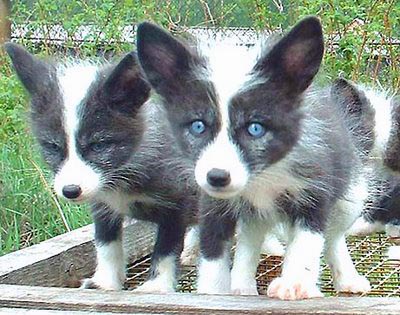
Another wild canid species is the fox. Long ago, the animal portion of the Russian fur trade involved feeding and generally looking after lots of caged foxes prior to them being harvested for fur. The problem was that foxes don’t like people very much, especially when the foxes are trapped in tiny cages, so they’d bite the workers any time they could. The people in charge got the bright idea that they’d interbreed the foxes that attacked humans less so that the next generation of fur foxes would be easier to handle. This process of breeding our aggression went very well and improved productivity, but then they hit a snag. Several generations in, their fur foxes changed from a solid color to a black and white mix, which was simply no good for fur. Many of them even ended up with floppy ears and blue eyes. (Sound familiar?) For more details, check out this video clip and these before and after pictures.
The foxes seemed to be domestication-ready just like wolves were. Geneticists learned that in canids, genes that regulate certain appearance-related characteristics are associated with genes that regulate adrenal response. Roughly speaking, this means that when one set of genes changes, it tends to drag another set of changed genes along with it. This is why canids that look “cute” also tend to be docile because the genes that were selected for reduced adrenal response not only reduce the animal’s fear and aggression, but they’re tied to the “cute” genes. This is why you tend to get docility along with “cuteness.” Why we happen to think domesticated animals are cute is another question entirely, but it’s certainly useful that we associate a dog’s cuteness with docility.
It seems reasonable to conclude that the genetic basis of domestication in canids is either well established or could be, given a little effort. I suspect it’d be possible to get a handle on a specific set of genetic changes that could turn any wild canid into a domesticated canid in a single generation, if gene therapy were used. For canids, this might not be cost-effective, since it seems to be pretty easy to breed them into domestication in a few generations. But maybe the process of genetically domesticating canids could be generalized to other animal families. Like bears, lions, or tigers.
Pretend I’m not wearing my crazy man hat and hear me out. There are species of bears and big cats that are threatened or endangered. While we can try to save their habitats, a multi-pronged strategy seems to be less dangerous to me. What if we could genetically domesticate bears and big cats? People already attempt to keep big cats as pets, so there’s a demand for it. Anyone who’s ever seen a baby polar bear could be persuaded to adopt one as a pet. So why not create a pet breed for each endangered animal, encouraging people to adopt them as pets and get their numbers to grow? When the time comes to introduce wild versions of them into their ancestral habitats, the genetic alteration could be reversed again in one generation.
If you still think I’m a crazy man, here are some data points that may convince you of the idea’s viability:
- There are already more tigers in the US than there are in the wild, and not all of them are in zoos.
- Only recently, a species of fox that lived on a Californian island dwindled down to 15 members. There was a mad scramble to save them and breed them in captivity, which they ultimately did, but it was very expensive.
- People try to own wild animals as pets anyway, so why not use their interest as a way of genetically banking wild animal DNA? Just check YouTube for videos of pet foxes, pet anteaters, pet cougars, pet squirrels, pet monkeys, and so on.